
Peters for Senate

A Different Kind of Campaign

The issues below start from the same premise: a government has to work before it can solve anything.

Back Home
Chris Peters speaking from a political soapbox stage

Debt and Budget

Congress has not passed a proper budget on time since 1997. Instead, we got continuing resolutions, massive omnibus spending bills, repeated debt ceiling hikes, last-minute deals, and actual or threatened government shutdowns.

In 1997, our national debt was $5 trillion. Now it is over $39 trillion. Not really a surprising result when you fail to properly budget for nearly thirty years.

We’re going to spend over $1 trillion this year to pay interest on what we already owe. That is more than we spend on national defense, and that money isn’t building anything. It’s not fixing roads, funding schools, or doing anything else we might actually want to do. It’s the bill for decisions both parties made, and neither wants to own it.

Older Americans are being told the programs they counted on are running short. Younger Americans are inheriting a debt they had no vote on. And in the middle, we’re all paying interest instead of solving either problem.

Historically, countries carrying this level of debt do not do well. America has been somewhat protected by the U.S. dollar’s status as the world’s reserve currency, but that is not a position we can assume will last forever.

A U.S. debt crisis could result in economic conditions worse than those of the Great Depression. Rising poverty, declining life expectancy, widespread social unrest. These are the predictable consequences of a problem we keep choosing to ignore.

Both parties are equally responsible for where we are. Both pay occasional lip service to fiscal responsibility. Neither has done anything about it. This is not a partisan failure. It is a government failure.

The math isn’t complicated. We need to reduce spending, increase revenue, or most likely both.

None of those options are politically comfortable. But the consequences of continuing to ignore this problem are far worse than the discomfort of addressing it.

This will require personal sacrifice. It will require supporting candidates who treat the national debt as a first-order priority, and continuing to support them when they make the hard calls that follow. What we owe the next generation is an America worth inheriting. Right now, we’re leaving them the bill instead.
Retirement Security

Social Security’s retirement trust fund is going to run out of money in 2033. When that happens, retirees will face an automatic 23 percent cut in Social Security benefits. Not a proposal. Not a negotiation. An automatic cut, written into the law.

Both parties know exactly when the cliff is. They have the date. They have the math. And rather than acting, they’ve made it worse.

The Social Security Fairness Act, passed in 2024 with broad bipartisan support, is the most recent example. It expanded benefits for certain retirees, a popular move, while moving the insolvency date forward by one year. No one wanted to talk about that part.

Social Security’s problems are easy to understand: fewer working Americans supporting greater numbers of retirees. The solutions are also straightforward, if uncomfortable. On the spending side: reduce benefits, raise the retirement age, or both. On the revenue side: remove the income cap on payroll taxes, raise those tax rates, or both. None of those options are an easy sell. But they are the realities we must face.

Medicare faces the same problem. The Medicare Hospital Insurance trust fund, which mainly funds hospital benefits, is also projected to be depleted in 2033. After that, dedicated revenue would cover only about 89 percent of scheduled costs. Efforts to address Medicare solvency have come and gone. The 2025 Trustees report still moved the depletion date up, largely because of higher-than-expected spending.

Ensuring Medicare is sustainable is even more complicated than Social Security, tied as it is to the broader challenge of healthcare reform. But that reform is possible and necessary if we are to keep our promises to current and future retirees without saddling future generations with ever more debt.

A growing share of the workforce, including gig workers, part-time workers, and the self-employed, has no access to an employer-sponsored retirement plan. For younger workers already skeptical that Social Security will be there for them, that’s a compounding problem.

Several states have demonstrated a practical solution: auto-enrollment IRA programs that cover every worker regardless of employer. The federal government could do the same: a universal, portable retirement account that follows the worker across jobs, with a government match for lower-income earners.

Not a replacement for Social Security. A floor that no one falls through.

Iowa has a lot of retirees who planned their lives around Social Security and Medicare. It also has a lot of younger workers wondering if anything will be left for them. Both deserve straight talk, and a senator who sees fixing this as part of fixing government, not just another campaign promise.

Healthcare

We’ve been fixing healthcare my entire life. Medicare and Medicaid. The Children’s Health Insurance Program (CHIP). Medicare Part D. The Affordable Care Act (ACA). And yet American healthcare costs more than any other developed country by a wide margin. And costs keep going up.

Most Americans don’t need to be told this. They feel it every month.

Our healthcare system was never actually designed. It’s an accumulation of patchwork policies built on top of each other over decades, each one trying to fix the problems created by the last. The result is several different systems awkwardly coexisting, and none of them working as well as they should.

Part of what’s driving costs is something nobody in Washington wants to admit: a significant portion of the healthcare delivered in America is of unproven benefit. We spend enormous sums on treatments, tests, and procedures that the evidence doesn’t support. A functional system would address that honestly. Ours doesn’t.

Here’s the core insight I keep coming back to: every reform has failed in part because we’ve been trying to solve two fundamentally different problems with one blunt instrument. The needs of a basically healthy person navigating routine care are completely different from the needs of someone managing a serious chronic or lifelong condition. Pooling those populations together distorts markets, drives up costs, and serves neither group well.

Markets where they work. Public support where they don’t.

My own thinking favors a framework that separates those two populations deliberately: a market-driven system for routine and catastrophic care, built around price transparency and real consumer choice, alongside a publicly supported system for Americans with serious chronic and lifelong conditions who need coordinated, predictable, long-term care.

That’s not a complete answer; the details matter enormously and I’ll be writing about them at length. But it’s a different starting point than anything Washington has tried.

Healthcare isn’t a failure of medicine. It’s a failure of governance. And until we fix that, the bills will keep rising, rural hospitals will keep closing, and Iowans will keep driving further to see a doctor.

Household Economics

Most Iowa families aren’t struggling because they’re doing anything wrong.

They’re working harder than their parents did. Earning more on paper. And yet housing costs more, healthcare costs more, childcare costs more, and somehow there’s less left over at the end of the month.

That’s not bad luck. That’s a pattern. And it’s been building for decades.

At the same time, wealth has become more concentrated than at any point since the 1920s. I’m not saying that to start a class war. I’m saying it because we remember how the 1920s ended, and because a society that stops rewarding work eventually stops working.

Both parties have talked about this for thirty years. Neither has solved it. Because solving it requires tradeoffs that are politically inconvenient, and a government capable of making hard decisions.

This is what government failure looks like in people’s actual lives. It’s not abstract. It’s the monthly budget that doesn’t add up, the job that pays more than your parents made but somehow covers less, the sense that the rules changed somewhere along the way and nobody told you.

The problems driving this, including healthcare costs, housing supply, and the price of raising children, aren’t mysteries. They’re the predictable result of decades of decisions, and decades of inaction. They show up on other pages of this site because they deserve serious treatment. But they all share the same root cause.

Fix the government. The rest becomes possible.

Political Polarization

I first experienced political polarization firsthand when I ran for Congress in 2016. It was disturbing, but also rather entertaining: I managed to be misjudged by both sides on the very same issue, which told me something about how little either was actually listening.

In 2018, running again, I met two college students who changed how I thought about all of it. One was the head of the campus Democrats. The other was the head of the campus Republicans. They were also roommates. They had learned to have in-depth conversations, even outright disagreements, without anger, and without seeing the other as somehow less than human.

Those two introduced me to Braver Angels, a national organization that formed shortly after the 2016 election with a simple but radical premise: that Americans across the political divide can talk to each other, and that when they do, something changes.

I’ve been involved with Braver Angels ever since. I’ve participated in workshops as both an attendee and a moderator, and have served as the volunteer state coordinator for Iowa since 2019.

What I’ve seen, time and time again, is this: most people are not the caricature the other side has made of them. When they actually sit down together, not to debate, not to win, but to listen, they find they have more in common than they imagined. The goal isn’t to change minds. It’s to broker understanding. That turns out to be both more achievable and more valuable.

The problem is that powerful forces work against this. Our information environment has fractured into distinct silos where each side sees a different reality and is fed a steady diet of the other side’s worst moments. And there are institutions, including both major political parties, whose power depends on keeping us angry and divided. A polarized electorate is an electorate that stays in its lane, votes reliably, and never asks too many questions.

Most Americans are exhausted by this. They’re not extreme; they’re reasonable. They’ve just been crowded out by a system that rewards conflict and punishes nuance.

That exhausted majority is who this campaign is for.

The experience of watching ordinary Iowans genuinely talk across the divide, rather than perform, is a big part of why I believe a different kind of politics is possible.

Back Home
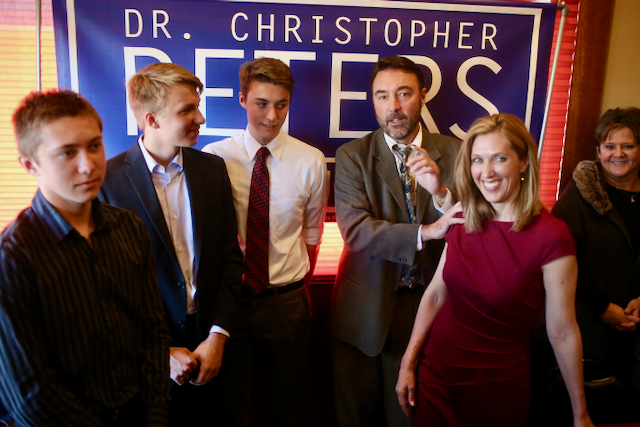
Chris Peters speaking at a campaign event